
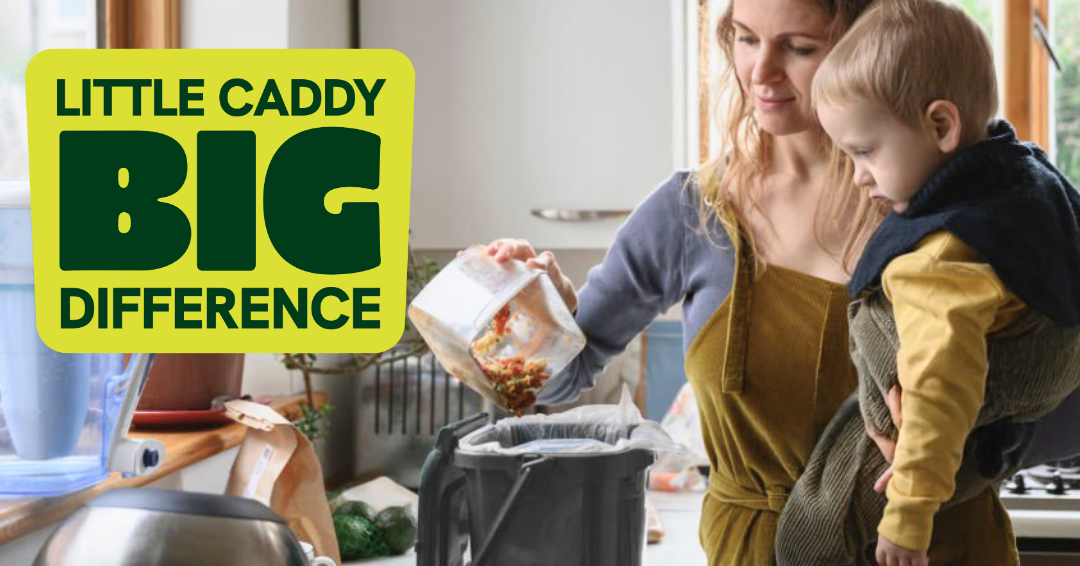
From April 2026, councils will be required to collect food waste from all homes on a weekly basis as part of new Simpler Recycling legislation. The change is part of the government’s plan to make it easier for residents to recycle, improve recycling rates and lower greenhouse gas emissions.
From January 2026, we’ll begin delivering new food waste caddies to every household in Hyndburn. You’ll receive two caddies, one small 7 litre caddy, designed to stay in your kitchen and a 23 litre caddy which will stay outside with your other bins. We’ll collect your larger food waste caddy from 1st April 2026 every week from your usual collection spot alongside your other bin.
Please do not put your food waste caddy out before 1st April 2026, it will not be collected before this date.
Everything you need to know about food waste recycling can be found on this page
What will I receive?
From 12th January 2026, we’ll begin delivering all you need to recycle your food waste. You’ll receive:
- 23 litre silver outdoor food waste caddy
- 7 litre silver kitchen food waste caddy
- A roll of caddy liners
- A bin collection calendar
- An information leaflet with everything you need to know about food waste recycling


When will you receiving your food waste recycling kit?
We’ll deliver everything you need to the front of your property starting on 12th January 2026. We’ll be beginning deliveries in Rishton (Monday North) and Oswaldtwistle (Monday South) and will cover the whole of Hyndburn in approximately 4-5 weeks
How to get started
It’s easy to recycle your food waste. Simply follow the steps below:
- Remember, food waste collection does not begin in Hyndburn until 1st April, so please wait until then.
- Put a caddy liner in your kitchen caddy then put your food waste in it.
- Whenever you need to empty your kitchen caddy, remove the liner, tie the top and put it in your outdoor food waste recycling caddy.
- Lock your outdoor food waste recycling bin by bringing the handle to the front.
- Put your outdoor food waste recycling bin out at your usual collection point by 7.30 am every week on the day we collect your waste or recycling.
- If you run out of caddy liners, simply tie a liner to the handle of your outdoor caddy and we’ll provide a new roll when we collect your waste.
All food waste can be recycled
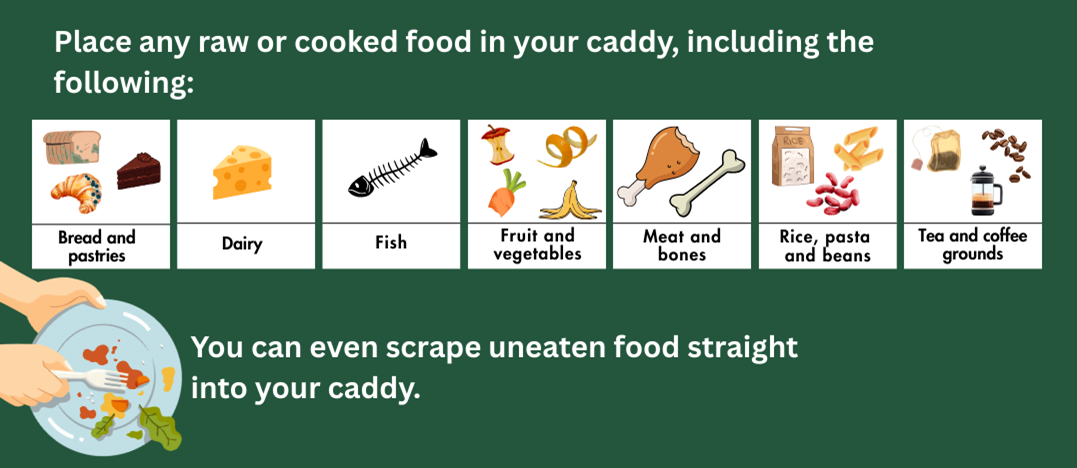
You can include all food waste from your home, including leftovers from meals, food that has gone past its use by date, and any other food waste, including:
- Tea bags (including the bag) and coffee grounds
- Fruit – raw and cooked
- Salad and vegetables – raw and cooked
- Vegetable and fruit peelings – including banana skins, cherry stones etc.
- Bread, cakes and other baked goods
- Pasta, rice, beans and pulses
- Meat – raw and cooked, bones
- Fish/shellfish – raw and cooked, including bones and shells
- Eggs and egg products (including eggshells)
- Dairy products (including cheese and yogurts)
- Tinned and dry pet food
- Small amounts of gravy, sauces or custard left on food
- Any meal or take-away leftovers
What can’t be recycled in your food waste
Please do not put any of the following in your food waste bins:
- Liquids, such as milk and oils
- Packaging (even if it states it is compostable)
- Cardboard
- Foil
- Plastic film
- Plastic bags (unless it is lining the caddy)
- Glass
- Other recycling
- Garden waste (including cut flowers)
Reasons to recycle your food waste
- Your collection will be easy and convenient.
- You will have more space in your household bin for non-recyclable waste.
- Food waste will no longer sit in bins waiting to be collected for two weeks, so there will be less smell from your grey bins and outdoor food waste bins are easier to clean if they get grubby.
- You’ll notice how you are producing waste and ways to eliminate it, such as purchasing small quantities, using meal planners, batch cooking, freezing and gifting food — which could save you money.
- Together with residents across the country, you will help to reduce the large amount of waste that ends up in landfill or incineration that could instead be converted into fertiliser, or biofuel to create energy.
- When food waste is sent to landfill it doesn’t harmlessly breakdown. It has a big impact on the environment as it rots and releases methane – a harmful greenhouse gas that is 25 times more potent than carbon dioxide. Likewise, as food waste is 70% water, sending food waste for incineration requires more energy to burn so recycling is a more efficient method of disposal.
What happens to the food waste which is collected
Your food waste is taken to an anaerobic digestion facility at Farington Waste Recovery Park in Leyland where it is broken down to produce biogas — a source of renewable energy that can generate electricity.
In the process, a digestate which is rich in nutrients such as nitrogen, phosphorus and other elements required for healthy plant growth and fertile soil is produced and can be used by farmers as a soil fertiliser.
Frequently asked questions
Why is the Council introducing a separate weekly food collection?
From April 2026, councils will be required to collect food waste from all homes on a weekly basis as part of new Simpler Recycling legislation. The change is part of the government’s plan to make it easier for residents to recycle, improve recycling rates and lower greenhouse gas emissions. Food waste is estimated to contribute 8-10% of global man-made greenhouse gas (GHG) emissions.
Food waste is currently the largest single material found in residual waste bins, making up approximately 33% of all waste collected from a household’s general waste. Collecting food waste separately on a weekly collection will ensure that it is recycled.
Around half of all residents in England already have a weekly food waste collection, but this will be new for Hyndburn.
The UK Government is providing councils with funding for new vehicles, containers and operating costs.
What bin will I get?
You will be provided with 2 food waste bins, a small kitchen caddy (7 litre) to keep inside for daily use, and a larger food waste bin (23 litre) for you to keep outside and put out weekly with your other bins. You will also be provided with free caddy liners to use in your food waste kitchen caddy.
The dimensions of the 7 litre kitchen caddy are height 23cm; width 26cm; depth 23cm.
The dimensions of the 23 litre outdoor caddy are height 40cm; width 30cm; depth 40cm.
Both caddys are light grey in colour and have a lockable lid.
How do I get a food waste bin?
A small kitchen caddy and a larger outdoor caddy will be delivered free of charge to every household within Hyndburn. We will begin delivering caddies to 39,000 households across Hyndburn from the middle of January 2026. All households will receive their caddies by the end of February 2026.
Inside your caddy will be your new waste collection calendar and instructions on what you can and cannot put in the caddy.
A free roll of caddy liners will also be placed in the caddy that you receive.
When will the food waste collections start?
Collections will commence in April 2026. As food waste will be collected weekly, you should present your outdoor caddy every week on your usual general (black bin), recycling (blue or brown bin) and garden waste (green bin) collection day.
From the 1st April 2026, place your caddy in your usual collection spot every week alongside your other bin.
What can I recycle in the food waste caddy?
You can include all food waste from your home, including leftovers from meals, food that has gone past its use by date, and any other food waste from your kitchen, including the following:
- fruit – raw and cooked
- salad and vegetables – raw and cooked
- vegetable and fruit peelings – including banana skins, cherry stones etc
- tea bags (including the bag) and coffee grounds
- bread, cakes and other baked goods
- pasta, rice, beans and pulses
- meat – raw and cooked, bones
- fish/shellfish – raw and cooked, including bones and shells
- eggs and egg products (including eggshells)
- dairy products (including cheese and yogurts)
- tinned and dry pet food
- small amounts of gravy, sauces or custard left on food
- any meal or take-away leftovers.
What can’t I recycle in the food waste caddy?
Please do not put any of the following in your food waste bins:
- liquids such as milk and oils
- packaging
- cardboard
- foil
- plastic film or plastic bags
- glass
- other recycling
- garden waste
Will the kitchen caddy smell?
Using the kitchen caddy for food waste is no different to having food waste in your current kitchen bin. The kitchen caddy has a lid which is lockable and will help contain any potential smells. We will also provide you with free liners to use in the kitchen caddy, this will help to keep your bin clean.
You can empty the kitchen caddy into the external food waste bin as regularly as you wish to prevent smells in your kitchen.
Will the outdoor caddy attract wildlife and how do I stop them getting into the bin?
The food waste will be collected in a 23 litre container, specifically designed to be pest and fox-resistant, featuring a locking lid to help prevent access.
Should the lid on your outdoor caddy break or come off, please ring the Council on 01254 388111 to order a replacement outdoor caddy. We will prioritise replacing any outdoor caddy with a broken lid.
What do I need to do if I run out of caddy liners?
A roll of recycled plastic bags will be supplied for free to collect food waste within the indoor caddy. When the bag is full, it will need to be tied and moved to the outdoor bin.
When your kitchen caddy liners are due to run out, tie a liner on to your 23 litre outside bin and the team will leave you more liners for free inside this bin.
What are the caddy liners made from?
The caddy liners we provide are made from recycled plastic. This is because in Lancashire food waste will be recycled via a process called anaerobic digestion (AD). Prior to the food waste going into the AD unit any bags are removed.
Why should I recycle food waste?
Food waste makes up over a third of the average household waste bin. Recycling food waste also means less waste is sent to landfill or incineration. Instead, it is taken to a specialist facility where it is recycled.
By recycling food waste, you’ll have less items in your rubbish bin and it’ll be cleaner.
Do I have to use the food waste caddy?
Recycling food waste in your food waste bin helps to reduce the amount of household waste in your grey bin. It is also much better for the environment as it means food waste is not going to landfill or being incinerated. Putting food waste in your grey bin could mean you are in breach of S46 of the Environmental Proection Act 1990 and subject to enforcement action
What if I don't produce any food waste?
Remember, there is no amount too small. Some food waste (such as banana peels, tea bags and citrus peels) are inevitable. These can now all be recycled and help make a big difference.
I already have enough bins, where do I fit another?
We understand that many properties already struggle with space, particularly those with smaller terraced gardens. Food Waste is mandatory and we have specifically chosen smaller bins with a carry handle to help with storage. The outdoor caddy is around 1/10th the size of your other outdoor bins.
The indoor kitchen caddy is small and will fit on a kitchen counter, under the sink or in a cupboard. People can use their own indoor container if they prefer something more stylish or fits better into the kitchen.
We appreciate your efforts to help increase the amount of rubbish which is recycled in our borough.
Can I put food waste in my green bin?
No you can’t put food waste in your green bin. In Lancashire food waste will be treated via anaerobic digestion and this process requires food waste to be collected separately.
I live in a flat/appartment/supported living accommodation with communal bins. Will I get a kerbside caddy?
Multi-occupancy premises (Generally flats, apartment blocks and supported living accommodation) will receive the smaller kitchen caddies but alternative arrangements will be made for kerbside collection. We’ll provide specific details for your building in due course.
What happens to the food waste?
Food waste that’s collected for recycling will be processed using anaerobic digestion (AD). AD involves the breakdown of biodegradable material to produce a source of renewable energy.
This is broken down to produce biogas which can be used to generate electricity and heat, and as vehicle fuel. A further by-product of AD is a digestate which is rich in nutrients such as nitrogen, phosphorus and other elements required for healthy plant growth and fertile soil which can be used by farmers as a soil fertiliser.
How can I find out more about food waste collections?
We’ll be delivering an information leaflet to every household in Hyndburn in December.
This webpage will also be updated as and when more information is available alongside our social media channels. For advice on reducing food waste, go to Love Food Hate Waste
Will Hyndburn Borough Council profit from the collection of food waste?
Hyndburn Borough Council collects all the waste and recycling produced by Borough residents, however after collection all waste goes to Lancashire County Council for disposal and recycling.
I am disabled and unable to put my bins out for collection, what can I do?
We offer an assisted collection for those residents who can’t manage to put out their bins, this can be requested via the contact centre on 01254 388111 or email enquiries@hyndburnbc.gov.uk for more information.